Amazon Bee AI Wearable Review: Complete Guide to the $50 Smart Device 2026
Imagine capturing every important conversation, idea, and commitment throughout your day—without ever pulling out your phone or opening a note-taking app. Amazon's new Bee AI wearable promises exactly that: a seamless bridge between your spoken words and organized, actionable intelligence.
For professionals drowning in meetings, students struggling to keep pace with lectures, or anyone who's lost a brilliant idea because they couldn't jot it down fast enough, the voice-first computing revolution offers a compelling solution. The challenge? Most AI wearables have failed spectacularly, from overheating hardware to identity crises about replacing smartphones.
The Amazon Bee AI wearable takes a different approach. Priced at just $49.99 with a $19 monthly subscription, this screenless device focuses exclusively on what voice AI does best: listening, understanding, and synthesizing spoken information into structured insights. After Amazon's acquisition of the San Francisco startup Bee in September 2025, the tech giant has rapidly evolved this platform into what may become the mainstream ambient intelligence device.
This comprehensive review examines the Bee Pioneer's technical capabilities, real-world performance, competitive positioning, and whether its privacy-first architecture justifies the subscription cost. I've analyzed dozens of user experiences, compared it against competing AI wearables, and evaluated its integration with Amazon's broader Alexa+ ecosystem.
You'll learn exactly what the Bee AI wearable excels at, where it falls short, who should buy it, and how it stacks up against alternatives like Plaud NotePin and Limitless Pendant. Let's dive into whether this $50 device represents the future of personal AI.
What is the Amazon Bee AI Wearable and Why It Matters
The Bee AI wearable represents Amazon's strategic re-entry into personal computing devices after discontinuing the Halo fitness tracker in 2023. Rather than tracking biometrics, this device captures and processes spoken conversations using advanced voice recognition and generative AI technologies.
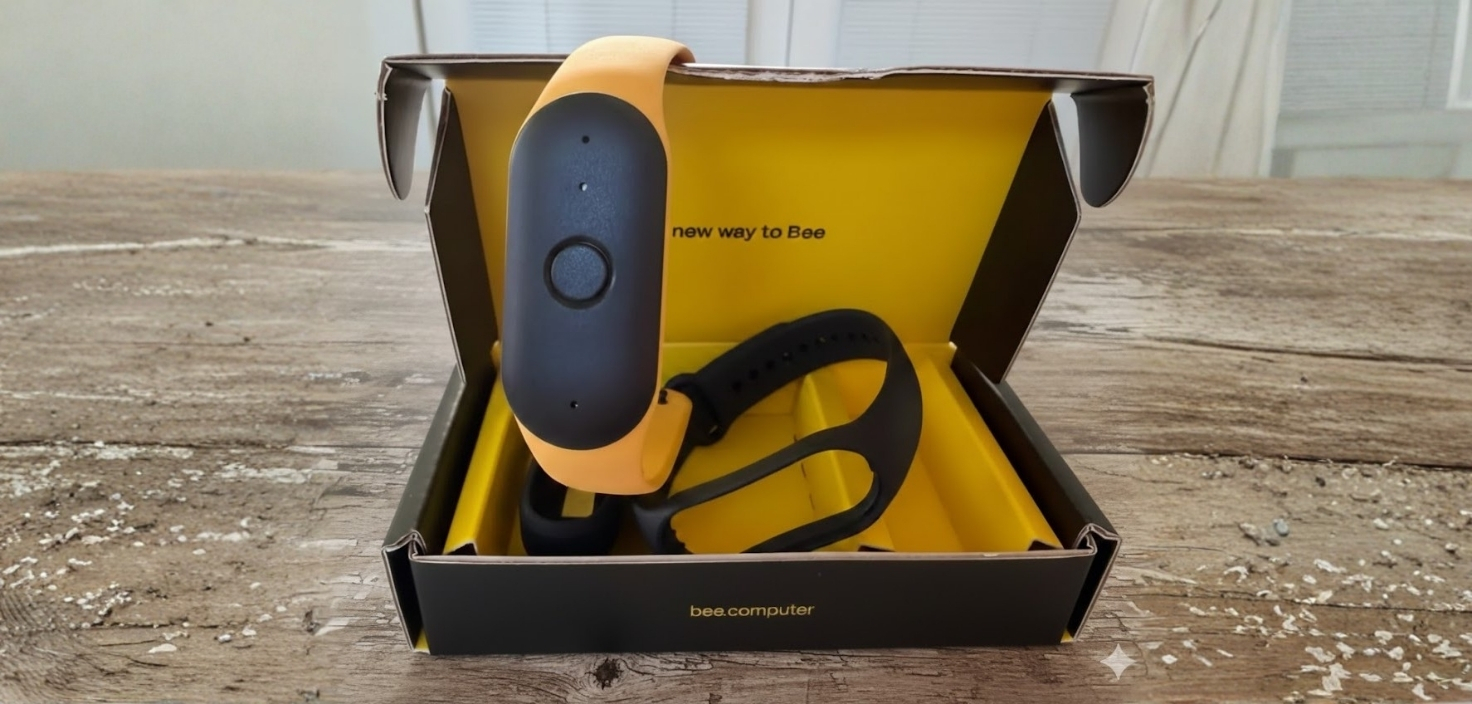
The core hardware consists of a lightweight modular pod featuring dual microphones with sophisticated noise filtering. Users can wear it as a wristband or clip it to clothing, allowing the device to record ambient conversations and transform raw audio into structured summaries, task lists, and searchable insights.
What makes this device significant is its approach to the failed promise of previous AI hardware. Unlike the Humane AI Pin or Rabbit R1—which attempted to replace smartphones with projection systems and suffered from thermal issues—the Bee works as a smartphone companion. It handles one task exceptionally well rather than trying to do everything poorly.
The device connects via Bluetooth to iOS devices (Android support coming in 2026) and streams audio directly to cloud processing servers. Within moments of ending a recording, users receive AI-generated summaries segmented by topic, with identified action items and emotional insights derived from speech patterns.
Key Features and Technical Specifications
Hardware Design and Components
The Bee Pioneer's minimalist design eliminates the two biggest obstacles facing wearable AI: battery drain and privacy concerns. By removing cameras and displays entirely, Amazon has created a device that achieves seven-day battery life while generating less social friction than video-recording competitors.
| Specification | Details | User Benefit |
|---|---|---|
| Audio System | Dual-microphone array with noise cancellation | Clear capture in noisy environments |
| Battery Life | Up to 160 hours per charge | Weekly charging routine |
| Connectivity | Bluetooth 5.0 with iOS | Reliable smartphone pairing |
| Visual Indicator | Single RGB LED | Discreet recording status |
| Charging | USB-C port (cable sold separately) | Universal charging standard |
| Water Resistance | Splash-proof rating | Safe for daily wear, not swimming |
The retail package includes two silicone wristbands in contrasting colors plus a versatile clip attachment. This modularity allows users to switch between wearing styles based on social context—professional settings might call for the discreet clip, while casual environments work well with the wristband.
AI-Powered Software Capabilities
The true innovation lies not in the hardware but in the generative AI processing that transforms recordings into actionable intelligence. The system organizes information across four primary dimensions that go beyond simple transcription.
Intelligent Segmentation divides conversations into thematic sections automatically. Rather than presenting a wall of text, the AI identifies distinct topics—introductions, technical discussions, personal anecdotes, and decisions—each color-coded for quick navigation.
Daily Insights analyzes speech patterns over time to surface behavioral trends. The system tracks mood shifts through linguistic markers and identifies changes in how users interact with specific individuals, offering a psychological dimension to personal analytics.
Proactive Actions represents the most advanced feature introduced in the 2026 update. By connecting to Gmail and Google Calendar through OAuth authentication, the AI drafts follow-up emails and schedules meetings based on commitments identified during conversations.
Contextual Templates optimize summaries for specialized environments. Medical consultation templates emphasize symptoms and treatment plans, while lecture templates focus on key concepts and references, ensuring the output format matches the input context.
Alexa+ Integration and Voice Queries
The Bee device serves as a mobile endpoint for Amazon's upgraded Alexa+ AI assistant, which provides conversational access to recorded history. Users can query their personal knowledge base with natural language—asking questions like identifying a restaurant mentioned days earlier—and receive instant answers drawn from transcripts.
This integration creates a unified personal knowledge graph where spoken information becomes searchable and cross-referenced. The system learns user preferences and communication patterns, becoming more accurate at predicting which information matters most.
Setup Process and Daily Operation Guide
Initial Configuration and Voice Training
Getting started with the Bee Pioneer requires approximately five minutes of initial setup through the iOS companion app. The process prioritizes accuracy in speaker identification, which significantly impacts the usefulness of conversation summaries.
Users begin by pairing the pod via Bluetooth, then complete a voice training exercise where they read several sample sentences. This allows the AI to create a voice profile that distinguishes the owner from other speakers captured in recordings.
For users wanting the full "Actions" functionality, linking Google services requires OAuth authentication granting access to Gmail, Calendar, and Contacts. Apple HealthKit integration is optional but enables correlation between physiological metrics and verbal patterns.
Control Gestures and Recording Management
The single-button interface uses intuitive gestures to eliminate the need for smartphone interaction during recordings. A short press starts or stops recording, indicated by a green LED. Double-pressing bookmarks important moments for immediate processing, while press-and-hold activates voice note mode for personal reminders.
The device includes intelligent auto-stop functionality, ending recordings after 15 minutes of silence by default. Users can customize this threshold from 15 to 120 minutes depending on their typical use cases—longer durations suit seminars and lectures, while shorter timeouts work better for quick meetings.
For device troubleshooting or transferring ownership, five rapid button presses trigger a hard reset, placing the pod into pairing mode indicated by a blue-green flashing LED.
Real-World Performance Analysis
Strengths and Success Scenarios
Testing reveals the Bee Pioneer excels at capturing "friction moments"—those spontaneous ideas and commitments that occur outside formal meeting structures. The device proves most valuable during commutes, hallway conversations, and impromptu discussions where pulling out a phone would disrupt flow.
- Summary accuracy: Generative AI excels at distilling lengthy discussions into coherent bullet points without losing essential context
- Ambient utility: Device disappears into daily routine, allowing complete presence in conversations without note-taking distraction
- Ecosystem connectivity: Seamless translation from spoken intent to calendar events saves significant administrative time
- Battery longevity: Seven-day runtime eliminates charging anxiety and makes the device truly wearable
The connection between spoken commitments and automated follow-up actions represents a genuine productivity multiplier. When a colleague mentions scheduling a follow-up meeting, the AI not only captures this but can draft the calendar invitation with appropriate context.
Limitations and Areas for Improvement
Despite strong core functionality, several limitations become apparent during extended use. Understanding these constraints helps set appropriate expectations for prospective buyers.
- Speaker attribution struggles: Groups exceeding three people often result in misattributed dialogue, with multiple speakers' words consolidated incorrectly
- Environmental noise sensitivity: High-frequency background sounds like coffee machines or wind can introduce transcription errors despite advanced filtering
- Media content confusion: Wearing the device while consuming entertainment results in TV shows and podcasts being summarized as personal memories
- Hardware durability concerns: Silicone wristband attachment points show tendency to detach unexpectedly, risking pod loss
The speaker identification challenges particularly impact professional users who need accurate meeting minutes. While acceptable for personal memory augmentation, the technology hasn't reached the precision required for legal or medical documentation without manual correction.
Amazon Bee vs Competing AI Wearables Comparison
The AI wearable market has evolved into distinct segments serving different priorities. Understanding how the Bee positions against alternatives helps identify the right device for specific needs and workflows.
| Device | Price Model | Best For | Key Advantage | Main Trade-off |
|---|---|---|---|---|
| Amazon Bee | $49.99 + $19/month | Personal memory and general productivity | Lowest hardware cost with strong ecosystem | Audio deleted immediately after processing |
| Plaud NotePin | $159 + $8.33/month | Corporate meetings and legal documentation | Superior speaker identification with audio retention | Higher upfront investment required |
| Limitless Pendant | $99-199 + $19-29/month | Knowledge workers needing searchable archives | Best-in-class multi-speaker diarization | Premium pricing for advanced features |
| Friend Pendant | $99 one-time | Emotional support and companionship | No subscription required for basic features | Limited productivity functionality |
Professional Productivity Tools Comparison
For users prioritizing meeting transcription accuracy and audio retention, the Plaud NotePin and Limitless Pendant offer advantages despite higher costs. Both devices store raw audio locally and in the cloud, allowing users to verify transcript accuracy by listening to original recordings—a critical feature for legal, medical, or compliance scenarios.
The Bee's privacy-first architecture intentionally sacrifices this capability, streaming audio directly for processing then immediately deleting source files. While this approach significantly reduces privacy concerns and storage requirements, it makes the device unsuitable for contexts requiring auditable records.
Mass Market Positioning Strategy
Amazon has positioned the Bee as a "mass market logger" balancing affordability with comprehensive features. The $49.99 entry price removes the barrier preventing experimentation, while the $19 monthly subscription aligns with other premium AI services.
This razor-and-blade model assumes users who adopt the hardware will maintain subscriptions once integrated into daily workflows. The strategy mirrors Amazon's broader ecosystem approach—hook users with accessible entry points, then deliver continuous value justifying ongoing payments.
Privacy Architecture and Data Handling
The Non-Retention Processing Model
Privacy concerns dominate discussions around always-listening devices, particularly those manufactured by major technology companies. Amazon and Bee have implemented specific architectural choices addressing these concerns through technical constraints rather than policy promises.
The system uses volatile streaming where audio transmits directly to processing servers without local storage. After transcription and AI summarization complete, source audio files are permanently deleted across all systems. This prevents creation of audio archives that could be subpoenaed, leaked, or compromised in data breaches.
Users maintain complete sovereignty over generated transcripts and summaries, with guaranteed permanent deletion upon request. The green indicator LED provides physical evidence of active recording, creating social transparency about when the device operates.
Legal and Social Considerations
Technical privacy safeguards don't eliminate legal obligations around recording consent. Jurisdictions vary significantly—some require all-party consent for recording conversations, while others permit single-party consent. Users must understand and comply with local regulations.
Beyond legal requirements, social dynamics create practical constraints. Early adopters report a "chilling effect" where conversation participants become guarded or uncomfortable knowing recording occurs. To address this, Amazon is developing "Topic Fencing" features that automatically pause recording when detecting sensitive keywords related to medical, financial, or legal matters.
Pricing Model and Long-Term Value Assessment
Cost Structure Breakdown
The Bee's affordability compared to previous AI wearables—contrast the $49.99 price with the $699 Humane AI Pin or $199 Rabbit R1—dramatically lowers barriers to entry. However, evaluating true cost requires examining the subscription component and usage patterns.
The $19 monthly subscription covers unlimited cloud-based AI processing, Actions integration with Google services, long-term transcript storage with cross-device syncing, and continuous software updates. For Amazon, this recurring revenue offsets significant GPU processing costs while locking users into the ecosystem.
Return on Investment Calculation
Value proposition depends heavily on recording volume and use case intensity. Users spending several hours daily in meetings or lectures generate higher ROI than casual users recording occasional conversations. A professional saving 30 minutes daily on meeting notes and follow-up emails justifies the $228 annual subscription through time savings alone.
Students can rationalize costs through improved study efficiency and reduced need for separate transcription services. Knowledge workers benefit from the personal knowledge base that makes previously lost information searchable and actionable.
Casual users seeking occasional memory assistance may find the subscription challenging to justify. For these individuals, wait for potential tiered pricing or consider devices with one-time purchase options.
Future Development Roadmap
Planned Updates for 2026
The current iOS-only version represents the foundation for broader platform expansion. Android support is expected by spring 2026, opening the device to global markets beyond Apple's ecosystem.
Software improvements focus on enhanced speaker identification through upgraded cloud processing engines, addressing the current limitation in multi-person scenarios. Additional "Actions" integrations will expand beyond Google services to include Microsoft 365 and Slack, allowing automated messaging in professional communication channels.
Long-Term Vision and Hardware Evolution
Amazon's ultimate goal involves moving processing to edge computing—performing transcription and summarization directly on device hardware. This approach would reduce latency, lower infrastructure costs, and provide enhanced privacy through fully local operation.
Future hardware iterations may incorporate vision capabilities, allowing AI to understand physical environments alongside verbal interactions. While the original Bee prototype included camera functionality deemed too expensive for a startup, Amazon's manufacturing scale could make a vision-enabled "Bee Pro" viable by 2027.
Frequently Asked Questions
Who should buy the Amazon Bee AI wearable?
The Bee suits professionals attending multiple meetings daily, students in lecture-heavy courses, and knowledge workers who struggle with information overload. Individuals who frequently lose track of commitments, ideas, or important details benefit most. The device is less appropriate for casual users who rarely need conversation capture or those requiring legal-grade transcription accuracy with audio retention.
Does the Bee AI wearable work without a subscription?
No, the device requires an active $19 monthly subscription for all AI processing features. The hardware alone cannot perform transcription or generate summaries—all intelligence operates through cloud-based processing covered by the subscription. Without an active subscription, the device functions only as a basic voice recorder without any AI capabilities.
How accurate is the Bee's transcription compared to professional services?
Transcription accuracy for single speakers in quiet environments exceeds 95%, comparable to professional services. However, accuracy drops significantly in noisy environments or conversations with more than three participants. Speaker identification remains the weakest element, often misattributing dialogue in group settings. For critical documentation requiring verification, devices with audio retention like Plaud NotePin offer superior options.
Can I use the Bee AI wearable in countries outside the United States?
The device functions globally wherever iOS support exists and Bluetooth connectivity operates. However, users must comply with local recording consent laws, which vary significantly by jurisdiction. Some countries prohibit recording conversations without all parties' explicit consent. Additionally, AI processing accuracy may vary for non-English languages depending on Amazon's model training, with optimal performance currently in English.
What happens to my recordings if I cancel my subscription?
Existing transcripts and summaries remain accessible for 30 days after subscription cancellation, allowing users to export important data. After this grace period, Amazon permanently deletes all stored transcripts. Since raw audio is never retained regardless of subscription status, users cannot recover original recordings. Plan to export critical information before canceling to avoid permanent data loss.
How does the Bee compare to using smartphone voice memos?
Smartphone voice memos require manual recording initiation, produce unstructured audio files, and lack AI summarization. The Bee offers ambient capture without interrupting conversations, automatic processing into organized summaries, and proactive action item identification. The tradeoff is losing raw audio retention. Smartphones work better for capturing specific moments you want to review exactly, while Bee excels at continuous ambient intelligence and information synthesis.
Conclusion: Is the Amazon Bee Worth Buying in 2026?
The Amazon Bee AI wearable represents the most pragmatic approach to personal AI hardware yet developed. By focusing exclusively on voice capture and intelligent processing rather than attempting to replace smartphones, Amazon has created a genuinely useful productivity tool that avoids the failures plaguing earlier AI devices.
For professionals spending significant time in meetings, students managing complex coursework, or knowledge workers struggling with information overload, the combination of $49.99 hardware and $19 monthly subscription delivers clear value through time savings and enhanced recall. The privacy-first architecture addresses legitimate concerns about always-listening devices, even if it sacrifices audio retention that some users require.
The device isn't perfect—speaker attribution needs improvement, subscription costs accumulate significantly over time, and social friction around recording remains challenging. However, these limitations feel surmountable through software updates and evolving social norms, whereas fundamental flaws in competing devices require hardware redesigns.
If you're considering the Bee, evaluate your daily recording volume honestly. Users capturing multiple hours of conversation daily will find immediate ROI. Casual users should wait for potential tiered pricing or improved features before committing to the subscription model.
As ambient intelligence transitions from concept to mainstream reality, the Bee Pioneer marks an important milestone—the first AI wearable that solves a real problem affordably without creating new ones. Visit Bee's official website to explore current availability and join the waitlist for Android support.