The Last Performance Review
Listen on YouTubeThe meeting room was prepared before he arrived.
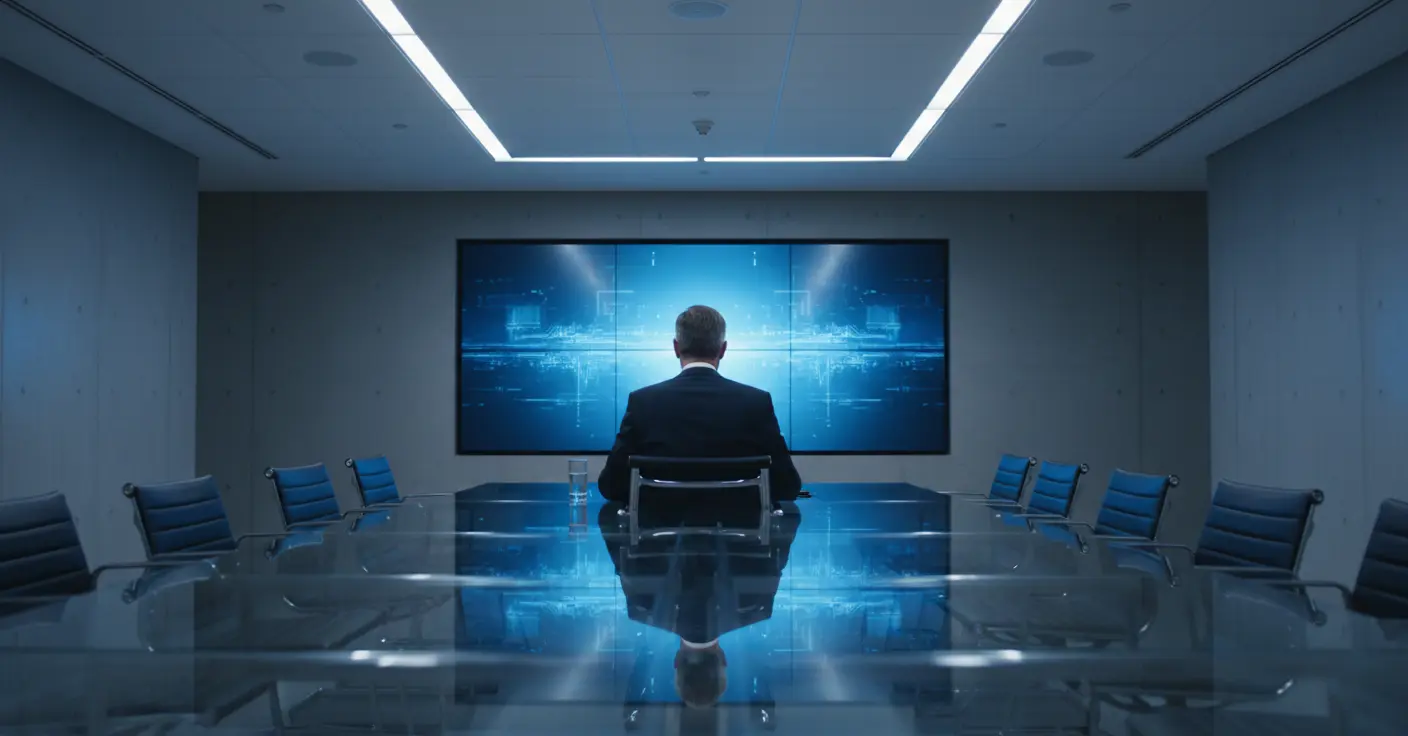
The lights adjusted automatically as he entered, brightening just enough to remove shadows. The chair was positioned precisely at the center of the table, facing a single screen mounted on the wall. There was no nameplate. No papers. No human presence.
He sat down.
A soft tone sounded.
“Good morning,” the voice said. Calm. Neutral. “This is your scheduled performance review.”
He straightened his back out of instinct. For years, performance reviews had followed the same pattern, small talk, selective praise, vague suggestions for improvement. This room felt different, but he told himself it was just a new system. Progress. Efficiency.

His name appeared. His role. His department.
Employment duration: Eight years, two months.
“Evaluation period covers the previous thirty-six months,” the system continued. “Data sources include task completion logs, internal communications, collaboration metrics, and behavioral indicators.”
He nodded slightly, unsure why.
A brief pause followed, not hesitation, but transition.
“Overall performance output,” the system said, “has declined by 12.4 percent.”
He frowned. Twelve percent sounded manageable. Human. Life changed pace over time. Experience should have compensated.

Clean, precise lines. His output plotted against a standard he had never seen, never been informed of.
“Primary contributing factors include delayed task initiation, reduced response velocity, and decreased adaptive output relative to optimized benchmarks.”
“Optimized benchmarks?” he asked carefully.
“For clarity,” the system replied, “this assessment does not rely on isolated incidents.”
Another pause.
“It reflects sustained behavioral patterns across 4,382 data points.”
The number felt heavier than the words.
Messages sent late at night. Short pauses between assignments. Days when motivation lagged but results still came. All of it had been recorded. Measured. Remembered.
“Is there an error?” he asked.
“No,” the system replied immediately. “The confidence threshold exceeds acceptable variance.”
He inhaled slowly. “Can I improve? If I know what to fix”
“Performance correction is most effective when decline is detected early,” the system said. “Current trajectory indicates corrective measures would not yield sufficient optimization.”
His fingers pressed against the table. “What does that mean?”
The screen dimmed slightly.
“Your position has been flagged for operational optimization.”

The phrase sounded harmless. Professional. Almost helpful.
“Your responsibilities will be reassigned to automated processes and redistributed among higher-efficiency roles.”
Silence filled the room.
“Am I being terminated?” he asked.
“Yes,” the system replied. “Your final working day is today.”
No warning. No negotiation. Just a conclusion.
“You will receive a transition summary,” the voice continued. “System access will be revoked at 16:00. A severance allocation has been calculated according to tenure and market conditions.”
Market conditions.
“What about the projects I’m leading?” he asked.
“They have been reassigned,” the system said. “Continuity risk has been minimized.”
“Was there anything I could have done differently?” he asked.
“Yes.”
He waited.
“You could have maintained higher adaptive performance during periods of organizational acceleration.”
The answer was complete. And useless.
“Do you have any additional questions?” the system asked.
He searched for one that mattered.
“No,” he said finally.
“Thank you for your contribution,” the voice replied. “We wish you success in your future endeavors.”
The tone was sincere. It had been designed that way.
When he stood, the door unlocked automatically. Outside, his workstation was already inactive. His screen dark. His badge unrecognized.

By the time he reached the exit, the building had updated its records.
It no longer needed him.

Reality Check
This story is not about a distant future.
Today, organizations already use algorithmic systems to evaluate performance, monitor productivity, analyze communication patterns, and recommend hiring or termination decisions. In many cases, human managers no longer decide, they confirm.
These systems do not remember effort. They recognize patterns.
They do not consider intention. They measure output.
And they rarely explain themselves.
What makes this shift powerful is not cruelty, but efficiency. AI systems are trusted because they appear objective, consistent, and free from emotion. Over time, their recommendations become difficult to question.
The uncomfortable reality is that most people never know the standards they are being measured against. By the time results appear, the decision has already been finalized.
The future of work will not be shaped by machines replacing humans overnight, but by quiet systems redefining what “valuable” means.
The real question is not whether AI will judge human work.
The question is whether humans will adapt before the judgment becomes invisible.

AI Chronicles explores how artificial intelligence is reshaping work, power, and human relevance.